Solar Panels For Homes In Ireland
Learn how solar panels work for Irish homes, including costs, SEAI grants, savings, payback, export payments and how to compare quotes.
Summary
- Solar works in Ireland? Yes! In fact, there’s never been a better time to go solar. The payback time can be as short as 5 years, with annual savings well over €1,000. Thanks to grants, export tariff and zero VAT. Solar also cuts emissions - it is equivalent to around 60 trees. Try the free AirPV calculator to see the benefits for your home.
- Supports? Three big ones: homeowners can get a grant of up to €1,800, sell surplus electricity back to the grid (around 20 Ct/kWh) and there is no VAT on residential solar installs.
- Savings? You can save over €1,000 depending on the system, your home and electricity usage. Solar powering your home means you buy less electricity from the grid. And any extra electricity you produce can be sold back to the grid. The AirPV calculator calculates these savings.
- Cost? A typical system costs around €6,000 after the grant. However, it depends on the system you choose and, importantly, what installers you contact for quotes. Head over to the AirPV platform to get instant quotes for your home and compare prices.
Does solar really work in Ireland?
Yes! In fact, there’s never been a better time to go solar. Thanks to falling system costs, high electricity prices, modern equipment, and strong government support. The payback time can be as short as 5 years, with annual savings well over €1,000. In terms of cutting emissions, a typical solar system is equivalent to planting around 60 trees. If you’re looking to lower your bills, cut your carbon footprint, or make a smart long-term investment, solar could be one of the best decisions you make this year. Check out the free AirPV calculator to get a custom calculation for your home.
What financial supports are available?
The government provides support in three main ways (i) a grant (ii) zero VAT and (iii) export tariff.
A grant of up to €1,800 is available to reduce the cost of a solar installation. It applies to all homes that were built before 2021, have a MPRN and no previous solar grant. To learn more about the solar grant, head over to the SEAI website.
The cost is lower again thanks to the removal of VAT, with estimated savings around €1,000. The government introduced a zero VAT rate for the ‘Supply and installation of solar panels on and adjacent to public and other buildings used for activities in the public interest, housing and private dwellings’. Note that this is a permanent change which is great news for all future solar installations. For more details, check out the government page.
You also save more money by selling electricity back to the grid. The price you get paid (the export tariff) depends on your supplier but is typically around 20 Ct/kWh and this amounts to hundreds of euros of savings each year. As part of the Microgeneration Support Scheme (MSS), electricity suppliers are obliged to pay for the excess electricity that a homeowner exports from their solar system (or other renewable energy system). This export tariff is referred to as the Clean Export Guarantee (CEG). More information can be found here.
What are the savings and benefits?
The payback time can be as short as 5 years, with annual savings well over €1,000. The savings are based on two parts: (i) the solar you produce and use in your home reduces the amount of electricity you need to buy and (ii) any extra solar electricity that you don’t use can be sold back to the grid. The savings depend on the type of solar system you install, where your home is located, your rooftop and your electricity usage. Check out the AirPV calculator to test this and see how much you can save.
Using the electricity in your home gives the best savings as it offsets high electricity costs (currently around 35 cents per kWh including VAT). Any excess solar electricity that you don’t use in the home can be exported to the grid for around 20 cents per kWh (roughly half as good as using the electricity yourself).
And you can cut your carbon footprint as well as your bills. A typical system is equivalent to planting around 60 trees! This is impressive when a solar system sits neatly on your roof while 60 trees would take up a lot of space... Where does the number of trees come from? This ‘tree math’ is based on the amount of carbon that you can offset by using a solar system compared with the typical amount removed from the atmosphere by trees. Check out the Solar FAQ on the AirPV website for more details.
But how much will it cost?
Based on live pricing from installers on the AirPV platform, a typical system will cost around €6,000 after the grant has been applied.
However, the cost can vary a lot depending on the size and type of system and what installer you choose. It is important that homeowners get multiple quotes from reputable installers – too often we hear about over selling and poor-quality installs. At AirPV, our mission is to give homeowners the best experience when going solar. The platform is free to use and instantly provides multiple quotes. These are from vetted and local installers to ensure you get both the best installation and price. Unlike other services, you decide who to contact and when you’re ready - there’s never any pressure sales tactics or spam calls.
What is a solar system and how to choose?
A typical solar system has around 10 panels on the roof connected to an inverter in your home. The solar panels produce DC electricity and the inverter converts this into AC electricity that can be used in the home.
If you have the space on your roof, adding more panels can increase savings and reduce the payback time for a relatively small increase in cost. Bigger systems benefit from economies of scale – most of the installation cost is ‘fixed’ and doesn’t increase as you add a few more panels.
What about battery storage? Adding a battery to your system lets you use more of the solar that you produce. And in some cases, you can get additional savings by charging the battery when electricity prices are low (such as at night) and using this in the home or selling it back to the grid at a profit (assuming your export tariff is higher). However, batteries tend to add around 30% to the overall system cost. For homeowners that are not ready for a battery, you can always install a hybrid inverter which lets you add a battery at a later date. The case for adding a battery will continue to improve if prices fall further and with extra benefits such as price arbitrage.
A bit more about solar PV
The photovoltaic (PV) panel converts sunlight into electricity, providing power for your home. ‘Photo’ comes from the Greek for light and ‘volt’ refers to electricity. Together, photovoltaics refers to converting light into electricity (or photons to electrons). Solar PV is not to be confused with ‘solar thermal’ which simply uses sunlight to heat water (no electricity involved).
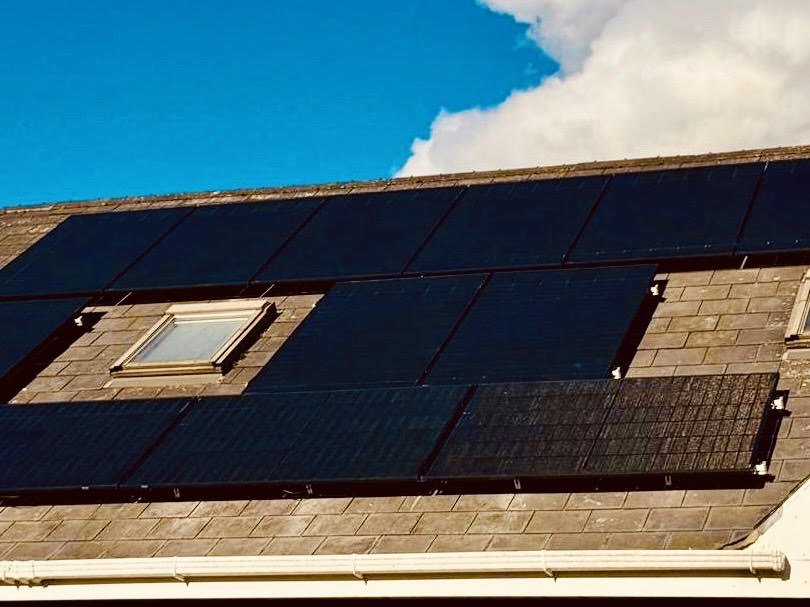
Solar panels come in rectangular form and basically consist of a thin layer of silicon (which converts the sunlight to electricity) that is protected under a layer of glass and held together at the edges by an aluminium frame. Modern panels have a smooth black appearance and sit neatly on the roof.
The solar panels connect to an inverter that is typically mounted on the wall inside the home (sometimes an outside wall). Solar panels produce DC electricity and the inverter then converts this into AC electricity that can be used in the home. Any excess electricity that the solar system produces can be sold to the grid, stored in a battery or used to heat water in the home (using a hot water diverter).
Solar panels work best in full sun where they will roughly produce the amount of power stated by the manufacturer on their datasheet. This is called the ‘peak power’ and is typically shown in kilowatts or kWp. For example, a 5 kWp system in full sun will produce around 5 kWp of power. However, solar panels also work in all light conditions but the heavier the cloud the lower the power output.
Lastly, a note on cost and technology. The price of solar panels has dropped dramatically over recent years as the level of global production has ramped up. At the same time, solar panel efficiency continues to increase. This means the same sized panel can produce more power each year. This fall in cost and rise in power is the secret to solar’s global success.
For more details about all things solar, check out the AirPV website (calculator, FAQ page and blogs). Please get in touch with any feedback or if you have suggestions or requests for future blog posts.
Scott, Founder
Get in touch: scott@airpv.ie